

This is Clinical Product Thinking 🧠, a weekly newsletter featuring practical tips, frameworks and strategies from the front line of clinical product.
Welcome, friends, this is issue No. 050 of Clinical Product Thinking 🎉. For issue 50, we’re going back to some of the fundamentals of clinical product management: what makes a product clinical, what the role actually does, and where it tends to go wrong.
Imagine you’re a clinical product manager at an EHR company.
The team is designing an alert for when a clinician prescribes a drug the patient is documented as being allergic to. There are three options you’re considering:
A — Hard stop. Prevent prescribing entirely with no override option. Maximum safety in theory, but potentially dangerous if the allergy record is wrong or outdated because you’ve removed clinician judgement.
B — Interruptive. A pop-up that forces a pause and justification before override. Preserves autonomy, but adds time, friction and cognitive load.
C — Passive. Show the allergy clearly without interrupting the workflow. Less alert fatigue, but a greater risk that it gets ignored.
Which would you choose?
Well sometimes, as the clinical person, you don’t get to choose at all. The decision is made without you and you’re brought in afterwards to sign it off. Ergo making you responsible for risk you had little influence over.
Clinical product management exists to close that gap. So let’s dive in.
1. What makes a product clinical?
My current working definition is this:
A clinical product is any product that influences clinical decisions, clinical workflows or clinical outcomes.
Influence is the key word here. A product doesn’t need to diagnose, prescribe or treat to be clinical.
What matters is whether the product influences something clinically meaningful: how a decision is made, how care is delivered or what happens to the patient.
If you’re wondering whether a product is clinical, ask:
What clinical decision, workflow or outcome could this product influence?
2. What clinical product management actually is
Clinical product management is still poorly-defined, but mine is:
Clinical product management is embedding clinical judgement throughout the product lifecycle.
This means being involved in shaping the product, rather than advising from the sidelines or reviewing it once it is ready to ship.
If we go back to the allergy alert example the clinical product decisions might include:
When should prescribing be blocked?
When should override be possible?
What level of risk justifies interrupting a clinician?
What information needs to appear in the alert?
What happens if the allergy data are incomplete or wrong?
Each of those choices has clinical implications, even if they appear to be product, design or workflow decisions. Asking clinical product questions throughout the lifecycle might look like:
Discovery: Are we solving the right clinical problem? What clinical decision or outcome are we trying to influence? What evidence should inform the approach?
Design: Does this reflect how care actually happens? What clinical risks could the design introduce? What safeguards are proportionate?
Build and test: Has anything changed in implementation that affects clinical behaviour? What happens in edge cases, with missing data or when users behave unexpectedly?
Deploy and monitor: What clinical outcomes or safety signals should we monitor? Who responds if something goes wrong? What would trigger intervention or rollback?
3. Turn clinical judgement into product decisions
The text book definition of clinical decision-making is:
The evaluation of evidence and the application of relevant knowledge to select appropriate interventions, providing high-quality care and minimising patient harm.
Clinical product management takes that same reasoning and applies it to decisions about how a product should work. For example:
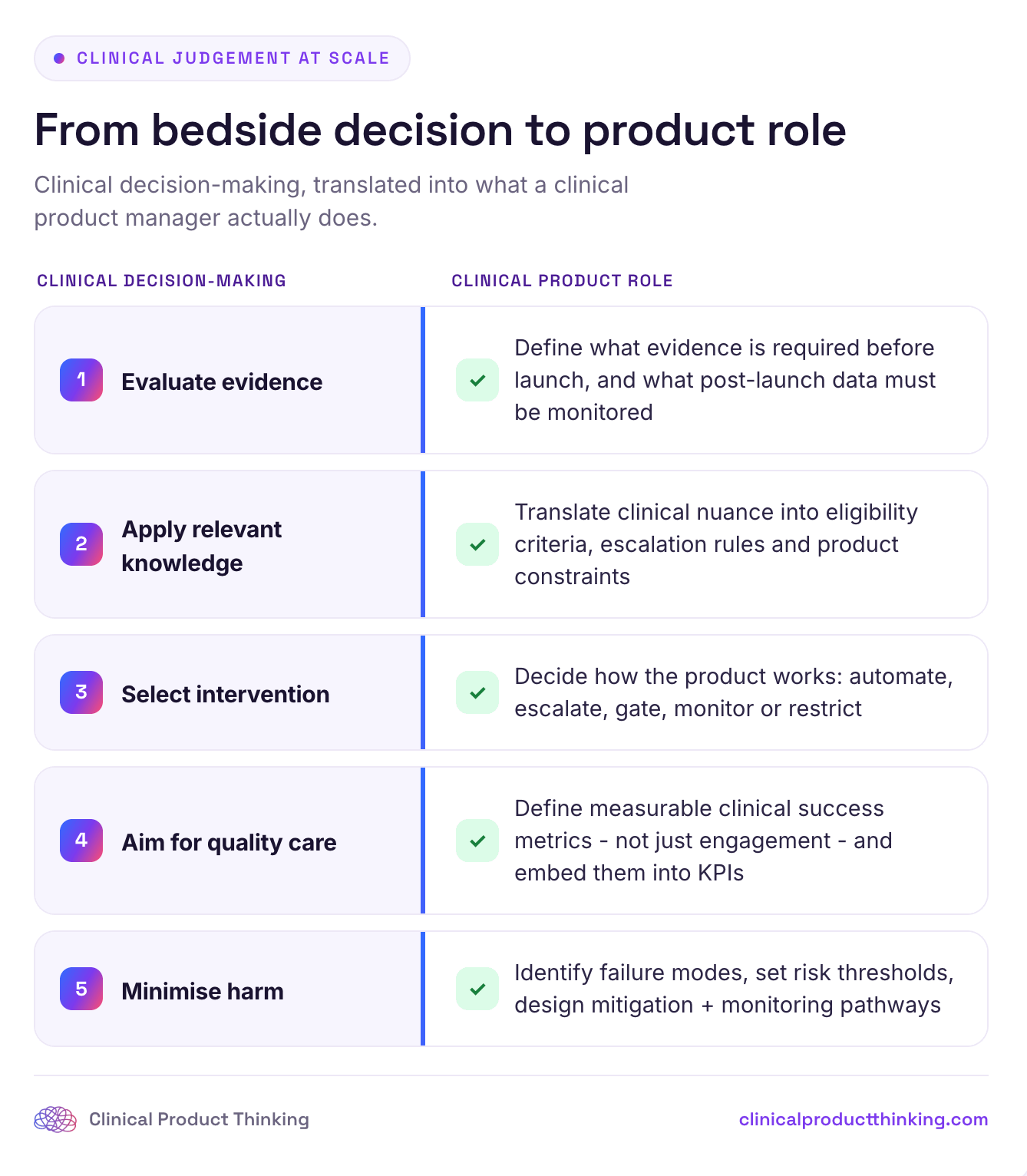
In clinical product, you’re not making a clinical decision for a single patient. You’re translating clinical judgement into the rules, constraints and behaviours of a product that may affect many patients.
4. So what makes a good clinical product manager?
I believe a strong clinical product manager needs three things:
Clinical scepticism + product optimism + commercial literacy
Clinical scepticism means questioning assumptions, looking for risk and asking what could go wrong. Product optimism means looking for new and creative ways to solve the problem rather than defaulting to the status quo. Commercial literacy means understanding how the business makes money, where costs sit and how product decisions affect viability.
Strong clinical product managers can hold all three together. They understand the clinical downside of commercial decisions and the commercial consequences of clinical ones.
Closing
Clinical product sits in the space between clinical judgement and product decisions.
Done well, it means clinicians are not just there to identify risk. They help shape what gets built, how it behaves, what trade-offs are acceptable and how success is measured.
That requires clinical scepticism, product optimism and commercial literacy and enough involvement in the product lifecycle to use all three.
For me, that is the core of clinical product management. Would love to know your thoughts! Just hit reply and let me know.
Join the next panel 🎤
Sign up for the next Clinical Product Thinking panel event on building clinical AI systems that patients actually trust. Tuesday 8th Sept, 7 pm, online. 👉 Sign up here.
Subscriber perks 🤩
Enjoying Clinical Product Thinking? Check out subscriber perks like deep dives on breaking into clinical product, embedding clinical safety into product decisions, building safe AI systems and more. 👉 View perks here.
That’s all for this week. See you next time! 👋
🤝 Work with me | 📅 Attend an event | ✍️ Send a message
Written by Dr Louise Rix, Head of Clinical Product, doctor and ex-VC. Passionate about all things healthcare, healthtech and clinical product (…obviously). Based in London. You can find me on LinkedIn.
Made with 💜 for better, safer HealthTech.