

This is Clinical Product Thinking 🧠, your weekly newsletter featuring practical tips, frameworks and strategies from the frontlines of clinical product.
Good afternoon friends, this is issue No. 028. This week we’re diving into the different cognitive modes of clinicians and product people and how clinical product managers learn to switch between them.
“The mindset of a clinician and the mindset of a product person are diametrically opposed.”
Said to me by a healthtech CEO.
It’s an uncomfortable truth that many startups and clinicians face when bringing in clinical support.
A clinician’s job is to recognise patterns quickly and mitigate risk.
A product manager’s job is to stay curious, explore ambiguity and resist jumping to solutions too early.
At first glance, these might not seem so different. In reality, they often collide.
Convergent Thinking: The Clinical Mode
Clinical training is built around convergent thinking. You rule out, narrow down and try to eliminate uncertainty. Pattern recognition becomes automatic.
Take for instance, a febrile child in a ten-minute GP consultation. Your mind immediately runs through the worst-case scenarios, e.g. could this be meningitis?
You assess the symptoms, examine the child, consider the history and make a decision: Does this child need urgent escalation?
You can see clinicians are trained to:
recognise patterns quickly
rule out danger
make defensible decisions with incomplete information
Clinical success depends on reducing the problem space safely and quickly.
Divergent Thinking: The Product Mode
Product development operates in the opposite cognitive mode. Product teams work in divergent thinking. Instead of trying to narrow the problem space, they seek to endlessly expand it.
Take the same febrile child scenario, a product team might ask very different questions:
Why do parents struggle with managing fever at home?
What was their experience in the GP surgery?
Why did they decide to seek care?
Why aren’t existing resources helping them?
Instead of collapsing the situation into a diagnosis, product thinking explores the system around the problem.
The goal is to understand why this situation occurs, so something better can be designed.
Clinicians are trained to collapse the problem space.
Product managers are trained to expand it.
The Misdiagnosis
Because of this tension, I’ve heard an incorrect narrative in the startup ecosystem:
“Clinicians make bad product managers.”
But that diagnosis is, in my opinion, totally wrong. The issue isn’t capability. It’s training.
Product managers didn’t leave the womb knowing how to run discovery interviews, design experiments or build opportunity-solution trees. They learned those skills through experience.
Product management is a craft. And like any craft, it can be taught… including, of course, to clinicians.
The Real Skill: Switching Modes
The people who become effective clinical product leaders don’t abandon their clinical thinking. They learn when to use each mode.
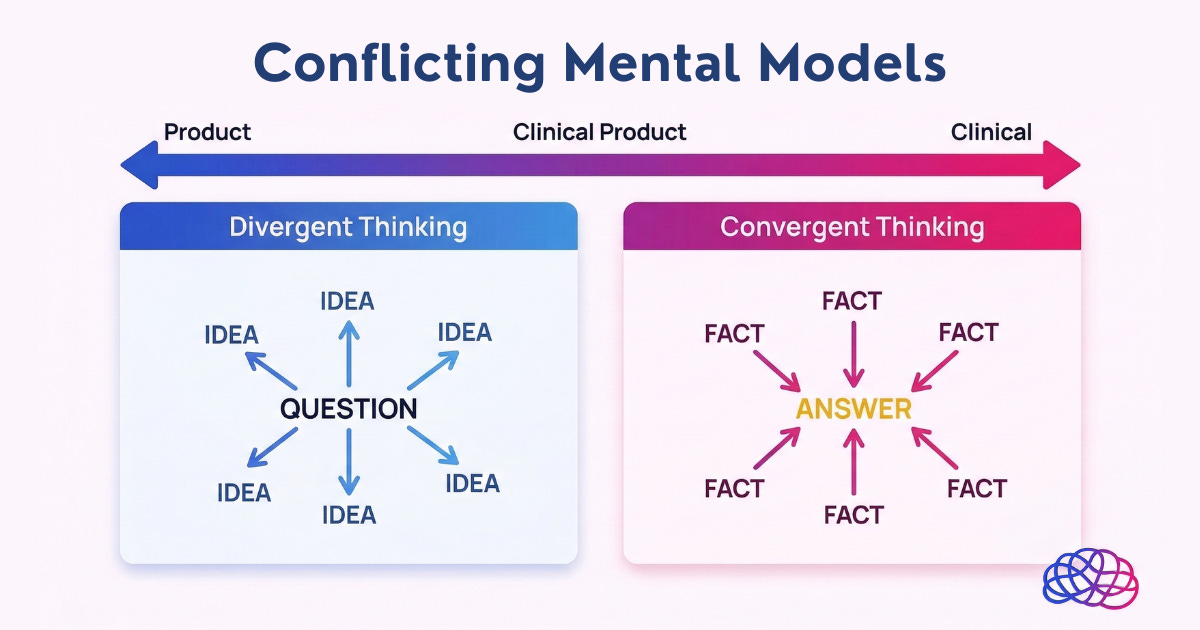
During discovery and product design, divergent thinking is critical. You explore the problem space, ask why repeatedly and resist jumping to solutions.
But when designing clinical pathways, prescribing criteria, or safety processes, convergent thinking becomes essential.
You narrow the options, you assess risk and you arrive at defensible decisions.
Clinical product thinking is the ability to move deliberately between these modes. Too much convergence too early leads to premature solutions.
Too much divergence too late means systems don’t get launched.
The real skill is knowing when to switch between them.
Join Us at HLTH Europe 🇪🇺
Danielle Brightman and I are running a panel event on clinical product with two incredible guest speakers. If you don’t know about HLTH, it’s the health tech conference you absolutely cannot miss.
👉 Register your interest for the panel here.
🎟️ Get your HLTH ticket here. (Use code: HE26PP_CPT250 for €250 off your ticket!)
Clinical Product Drinks ✨
📆 25th March, 6:30pm, The Folly.
Join for a drink with other folks at the front line of clinical product. This is an informal evening to mingle and share experiences. No agenda, no panel or slides. 👉 Get your ticket here.
Hiring Spotlight 🚀
Heidi Health are hiring a Clinical Associate. This role sits within the Customer Success team, so while it isn’t a pure clinical product role, it would be an excellent stepping stone for clinicians interested in moving towards clinical product management. 👉 Apply here.
That’s all for this week. See you next time! 👋
🤝 Work with me | 📅 Attend an event | | ✍️ Send a message
Written by Dr.Louise Rix, Head of Clinical Product, doctor and ex-VC. Passionate about all things healthcare, healthtech and clinical product (…obviously). Based in London. You can find me on Linkedin.
Made with 💜 for better, safer HealthTech.