This is Clinical Product Thinking 🧠, your weekly newsletter featuring practical tips, frameworks and strategies from the frontlines of clinical product.
Good afternoon friends, this is issue No. 025. This week, we’re talking about balancing speed vs safety in clinical product and why the best CPMs reject this false trade-off.
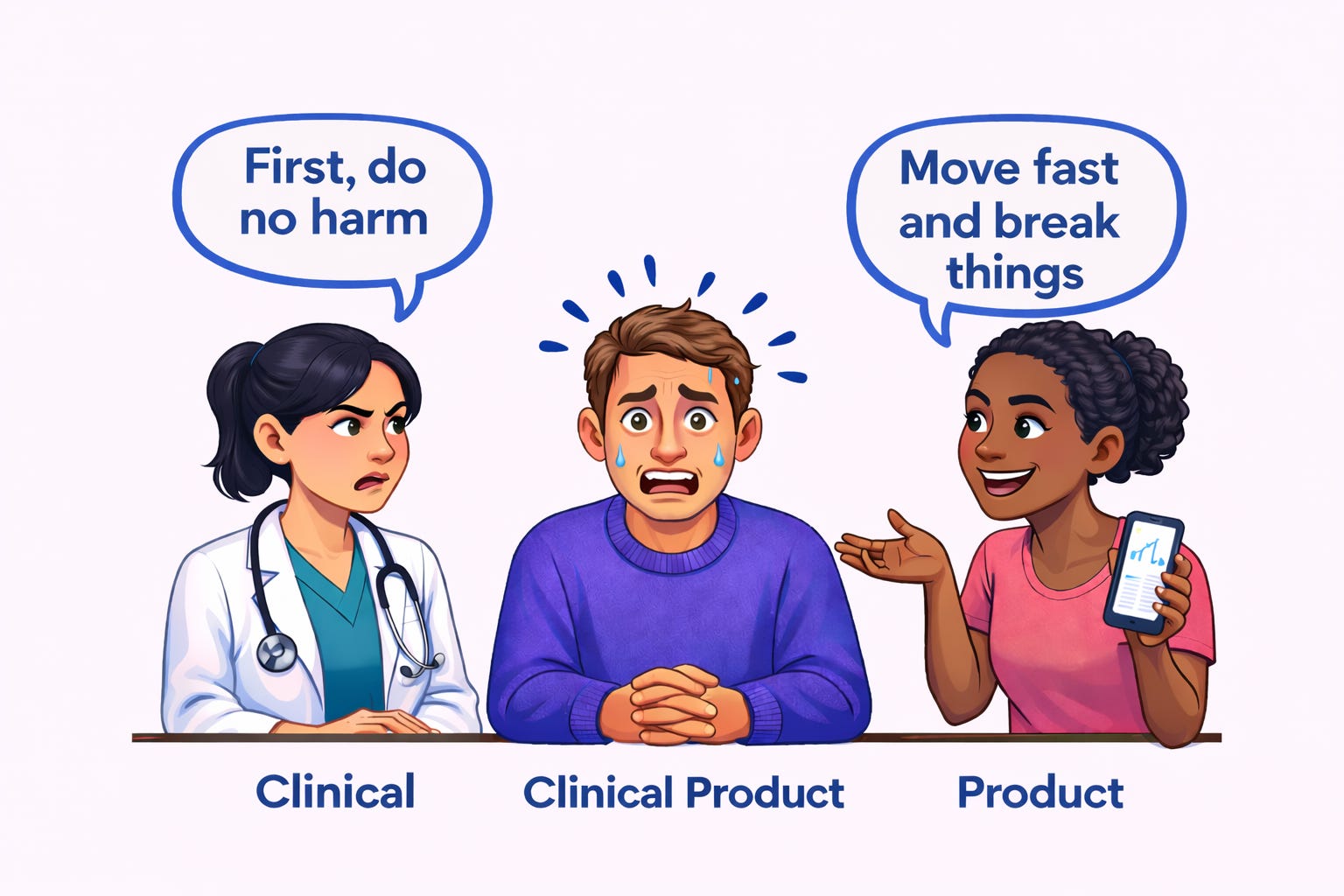
In startups, the mantra is clear: “Move fast and break things.”
In medicine, it’s even clearer: “First, do no harm.”
If you work in Clinical Product, you sit between those two worlds.
You are asked to move with urgency… and with restraint.
To accelerate progress… without compromising safety.
To ship quickly… and to design responsibly.
One side prizes speed. The other prizes certainty.
And you’re the one balancing both to find a pragmatic path forward.
Why Going Fast in HealthTech Can Feel Impossible
"Can we just ship this and iterate later?" The question no CPM wants to hear.
In consumer tech, broken features mean frustrated users and poor reviews. In healthcare, the consequences are potentially far more serious. Those stakes fundamentally change what “speed” actually means.
Here's what I've learned from teams spending months undoing "quick wins":
Speed without safety isn't speed at all; it's expensive future rework disguised as progress.
The real paradox? The safest, fastest way to build in healthcare often feels painfully slow upfront.
Examples I see constantly:
Teams that delay clinical safety input until late-stage testing often discover fundamental issues, forcing substantial redesign rather than small, early corrections.
Products built without clinicians in early discovery reach customers who don’t find them useful, fit for purpose, or safe, leading to stalled pilots, rework or quiet disengagement.
Features designed without proper consideration of edge cases break down in real-world use, forcing reactive fixes in production.
The CPM Approach: Measured Speed
Great Clinical Product Managers don't just ping pong between clinical and product teams, they internalise both mantras and create a third way: measured speed.
Instead of choosing between "move fast" and "do no harm," they ask: "How do we move fast because we have the systems/processes to ensure we’re doing no harm?" (not as pithy, I’ll admit!)
This might look like:
Building hazard identification into design sprints, not bolting it on later. When CPMs bring clinical safety thinking into wireframing, they catch issues when they’re easy to fix, not when they require architectural change.
Translating safety into usable guardrails, not vague blockers. Instead of saying, “This isn’t safe,” effective CPMs say, “This creates a medication error risk. Here are three design patterns that eliminate it while preserving the experience.”
Helping teams go slow where it matters so they can go fast everywhere else. Not every feature requires the same level of clinical scrutiny. CPMs clarify which decisions need formal clinical sign-off and which are safely reversible.
Why "Slow is Smooth" Wins Every Time
The irony is obvious once you see it: teams that feel "slow" because they're investing in clinical rigour upfront often ship faster overall.
Approval processes don’t turn into urgent fire drills; requirements were clear from the start.
Critical workflow flaws aren’t discovered at go-live, when changes are slow and costly.
Clinical incidents are rarer, and trust with providers and patients remains intact.
Safety issues are designed out early, rather than patched in later.
The result is what every HealthTech leader actually wants: safe speed.
The Compound Effect of Smooth
Teams that embrace "slow is smooth" don't just ship better products, they build better product muscles.
Clinical thinking becomes embedded in product culture, not an external checkpoint. Product managers start asking safety questions naturally.
Product thinking influences clinical processes, making safety reviews faster and more actionable.
Regulatory requirements are treated as early design constraints, not last-minute surprises.
Over time, this integration creates something remarkable: teams that can move fast because they've internalised how to do no harm.
Over to You
The next time you feel that familiar tension between speed and safety, remember: you're not choosing between them. You're figuring out how to achieve both.
The question isn't "How fast can we go?" or "How safe can we be?"
It's "How do we build the systems and infrastructure that let us be fast and safe?"
Hiring Spotlight x 3 🚀🚀🚀
1️⃣ Dyad
Dyad are hiring a Chief Clinical Product Officer, and this is the first CCPO role I’ve personally seen. 🤩 This is a senior executive role owning product strategy end-to-end for Dyad’s clinically grounded AI platform, combining deep NHS credibility with real startup product leadership. If you’ve been asking what the C-suite endpoint for Clinical Product looks like, this is it. 👉 Apply here.
2️⃣ Semble:
Sara Fikrat, CPO at Semble, is hiring a Clinical Product Manager to scale clinical safety within their cloud-based clinical system used by thousands of clinicians. I caught up with Sara about the role and they’re looking for someone who can embed clinical safety by design while partnering closely with product and engineering, combining DCB0129 governance with real roadmap influence. 👉 Apply here.
3️⃣ Hesta Health
Hesta Health are hiring a Clinical Operations Associate. You won’t usually find ops roles here but as a favour to the team (who are mega) here we are. This is an excellent opportunity for anyone looking to break into HealthTech and who is passionate about redefining postnatal care. (Also gaining startup experience in an operations role is a good way to eventually move into product). 👉 Apply here.
That’s the public post for this week. See you next time! 👋
🤝 Work with me | 📅 Attend an event | | ✍️ Send a message
Written by Dr Louise Rix, Head of Clinical Product, doctor and ex-VC. Passionate about all things healthcare, healthtech and clinical product (…obviously). Based in London. You can find me on Linkedin.
Made with 💜 for better, safer HealthTech.
[NEW] Want to Go Deeper? 👇 Join Paid
Below is the recording from our recent panel with Danielle Brightman (Numan), Tulsi Patel (Hertility), and Dr Yath Premadasan (Flo Health), moderated by me.
We share an honest, expert perspective on how to find and secure your dream role in Clinical Product and how to truly nail the interviews when you get the opportunity.