

This is Clinical Product Thinking 🧠, a weekly newsletter featuring practical tips, frameworks and strategies from the front line of clinical product.

Welcome, friends, this is issue No. 049 of Clinical Product Thinking. This week we’re talking about the skill clinical people are often judged on but are rarely taught.
Something I hear from hiring managers a lot is that clinical product managers are often clinically excellent but struggle to explain the commercial implications of their decisions. This isn’t really surprising if you think about it.
For clinicians coming from public healthcare systems, we’ve often not had to think of healthcare in monetary terms. But in HealthTech, clinical decisions affect cost, capacity and revenue, while commercial decisions can change the care patients receive.
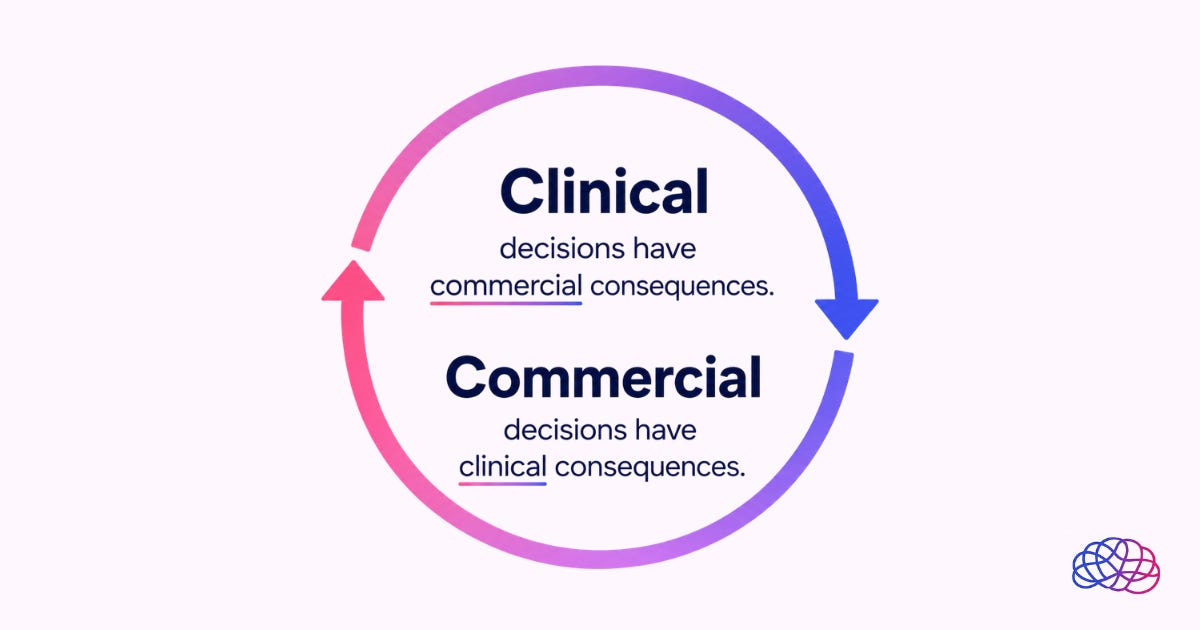
For example, say you decide to add a mandatory clinician review to a patient flow because you’ve judged it as high risk. The review may reduce clinical risk but it also changes the cost of serving every patient.
Or if the business has decided to trim consultation length to fit more reviews into the day: you’ve changed how much time there is to catch something potentially serious.
Either decision may be reasonable but if you only consider one side, the trade-off is made without fully understanding it.
Here are 4 principles to consider as you’re building commercial nous:
1. Make trade-offs visible
A clinical recommendation is incomplete if it only describes the clinical benefit.
Take the mandatory clinician review example we discussed above.
Clinically, it might catch a missed deterioration. Operationally, you’ve added time to the pathway and that’s where the commercial hit comes from: every review costs money to serve.
None of that means you should remove the review. But it does mean being explicit about what that cost is so that the team can see the decision properly.
For any meaningful product decision, write down:
Clinical consequence: what could this improve or put at risk for patients?
Operational consequence: what does it mean for clinicians, support teams or workflow?
Commercial consequence: what does it mean for cost, capacity, revenue or renewal?
Recommendation: which option do you support, and why?
Then, when you are presenting it, lead with the consequence most relevant to the decision-maker.
2. Users ≠ customers
The user is the person who interacts with the product. The customer is who pays for it.
In direct-to-consumer weight loss, for example, they’re the same person. Simple.
But in a lot of healthtech, they’re not. An employer buys the mental health benefit. The employee uses it. An insurer funds the chronic care programme but the patient lives it.
When users and customers are different, you need to consider what good looks like for both. A happy customer does not mean the product works well for the user. And sadly great clinical outcomes do not guarantee renewal if the payer can’t see their return.
For your product, write down who uses it and who pays for it. If they’re different, ask what the payer is motivated by. That will decide whether you survive contract renewal.
3. Understand unit economics
Unit economics answer one question: is each patient, or each customer, actually viable?
You definitely don’t need to build an entire financial model. But it is helpful to understand key terms when they come up. Three worth knowing at a minimum:
Customer acquisition cost (CAC): what it costs to acquire one customer.
Lifetime value (LTV): what that customer is worth over their lifetime. Most subscription businesses want LTV to be at least three times CAC.
Contribution margin (CM): what’s left from each patient after the variable costs of serving them. This is the one clinical people move most. Clinician time, medication cost, a manual review step: every one of those impacts the contribution margin. (Bonus points if you want to learn the difference between CM1, CM2 & CM3, more here).
So when you add a safety step, you’re not just adding safety. You’re changing the economics of every single patient.
One tip is to ask someone in finance or commercial to walk you through the business’s financial model, even if informally. Understand what drives revenue, what drives cost to serve, and where clinical decisions land.
4. The model matters
A monk once told me something that has stayed with me: “Advice doesn’t work in the abstract.” And neither do product metrics!
Engagement is not a universal good. Retention is not always the goal. What either one means depends entirely on the model.
In a fixed-fee contract, engagement protects renewal - the payer wants to see people using what they bought. But it also increases cost to serve.
In a usage-based model, engagement is the revenue.
And in some models, more engagement is a warning sign, not a win. If you’re optimising for return visits in mental health or chronic care, ask whether you’re building value or building dependency.
Adoption is not the same as revenue. Retention is not the same as good care. A strong clinical product person always knows which metrics actually matter in the clinical context. They also ask the harder question: could optimising those metrics ever work against the patient? If the answer to that is yes, consider that tension as your job to own.
The takeaway
Clinical product is about building things that are not only clinically safe but also commercially sustainable, because a company that runs out of cash can’t deliver great care.
You don’t need an MBA to be successful but you do need to speak enough commercial to build influence.
Want to learn more? Check out:
📎 50 Commercial Terms Every CPM Needs to Know
A practical cheatsheet covering business models, unit economics, revenue, retention and healthcare-specific terms. 💪
Join the next panel 🎤
Sign up for the next Clinical Product Thinking panel event on building clinical AI systems that patients actually trust. Tuesday 8th Sept, 7 pm, online. 👉 Sign up here.
Subscriber Perks 🤩
Enjoying Clinical Product Thinking? Check out subscriber perks like deep dives on breaking into clinical product, embedding clinical safety into product decisions, building safe AI systems and more. 👉 View perks here.
That’s all for this week. See you next time! 👋
🤝 Work with me | 📅 Attend an event | ✍️ Send a message
Written by Dr Louise Rix, Head of Clinical Product, doctor and ex-VC. Passionate about all things healthcare, healthtech and clinical product (…obviously). Based in London. You can find me on LinkedIn.
Made with 💜 for better, safer HealthTech.