

This is Clinical Product Thinking 🧠, a weekly newsletter featuring practical tips, frameworks and strategies from the front line of clinical product.
Welcome, friends, this is issue No. 055 of Clinical Product Thinking. Today we’re looking at a new report that could shape how clinical AI is regulated in the UK.
Last week, the National Commission into the Regulation of AI in Healthcare published its final report. It contains 44 recommendations for how the UK should regulate AI used in healthcare. Here are the 5 takeaways I think are particularly relevant for clinical product people:
Regulation needs to follow AI after launch
One of the key themes from the report is that regulating clinical AI systems doesn’t (or shouldn’t) stop when a product reaches the market.
AI performance can change depending on:
the patient population
data
clinical setting
changes to the underlying model
human factors, like the way a clinician uses it
The report recommends a much stronger approach to ongoing monitoring and post-market surveillance. That includes monitoring for performance degradation and appropriate escalation before an incident occurs. They also suggest a unique device identifier should be explored as a potential mechanism for traceability within the patient record, enabling audit for particular devices.
My take: A CEO said to me last week that we should think about clinical safety as part of the product build. I couldn’t agree more. If clinical AI requires ongoing monitoring, traceability and escalation mechanisms after launch, those capabilities need to be designed into the product from the beginning.
Clearer boundaries on medical devices
The report recommends clearer boundaries on what counts as a medical device, including clarifying when software intended for administrative purposes, general wellbeing and certain forms of decision support is not a medical device.
Interestingly, it recommends greater consideration of the actual design and functionality of the product, alongside manufacturer claims and promotional materials, when determining intended purpose.
My take: This could become very relevant for clinical product teams working close to the medical device boundary. Focusing on what the software actually does rather than how it’s described means clinical product decisions become even more important.
AI needs a sensible way to change post-approval
Traditional medical-device regulation assumes that products are relatively stable. AI changes this paradigm. The Commission recommends clearer approaches to Predetermined Change Control Plans (PCCPs). These could allow manufacturers to agree the boundaries within which a product can change without going through lengthy review.
Staged authorisation for AI
Another particularly interesting recommendation is so-called staged authorisation. Rather than requiring a product to be fully proven before it enters real clinical environments, an AI medical device could initially be authorised for a tightly controlled deployment.
This solves a circular problem with AI regulation. The regulator wanting real-world evidence and real-world evidence requiring the product being cleared to use.
Safe product ≠ safe deployment
A medical device may meet the requirements for regulatory approval and still be deployed unsafely. The conditions into which it is deployed can materially impact safety.
Recommendation 26 says manufacturers should specify in pre-market submissions and risk management files the operational conditions needed for safe deployment and use.
Recommendation 28 strengthens this by stating allocation of responsibilities should be included in contracts between manufacturer and healthcare provider.
So, what changes?
For now, these are recommendations rather than new regulatory requirements.
However, they give us a useful indication of where UK regulations are heading: more lifecycle monitoring, more scrutiny of what products actually do, more flexibility for controlled change and greater focus on what happens when AI enters clinical practice.
Read the full report here.
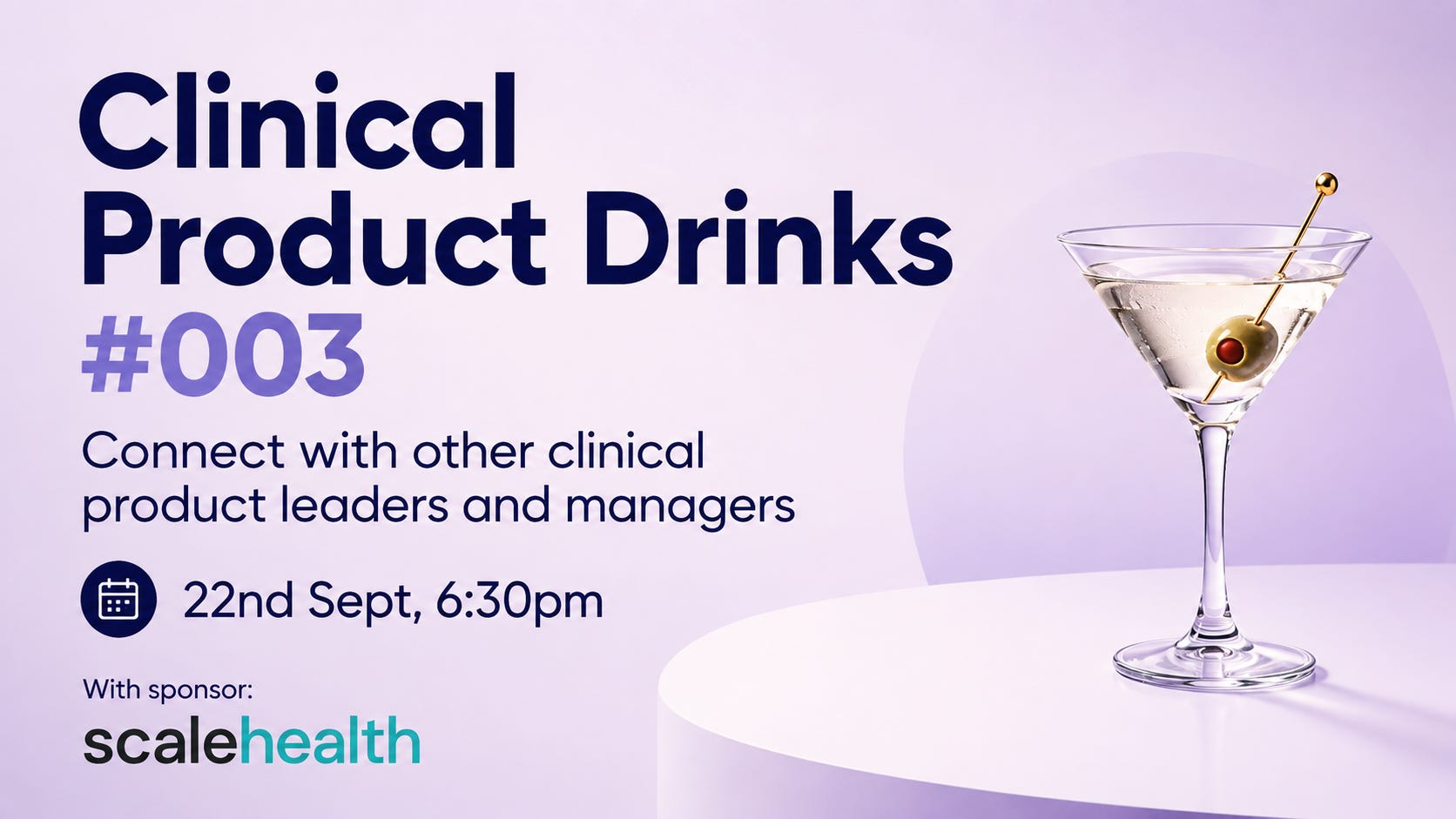
Clinical Product Drinks 🍸
Join the next clinical product drinks! A chance to meet other clinical product leaders and managers and share the good, the bad and the ugly. 👉 Sign up here.
Resources
A collection of things I’ve been reading and will be attending. Say hi to me there! 👋
📅 Digital Safety Practitioners Course | 17th September | Sign up here
📅 Patient Safety & AI Workshop | 6th October | Sign up here
📅 Introduction to Medical Device Regulation for Software and AI Technologies | Webinar series with Hardian Health | 12th November | Sign up here
That’s all for this week. See you next time! 👋
🤝 Work with me | 📅 Attend an event | ✍️ Send a message
Written by Dr Louise Rix, Clinical Product, AI & Safety, doctor and ex-VC. Passionate about all things healthcare, healthtech and clinical product (…obviously). Based in London. You can find me on LinkedIn.
Made with 💜 for better, safer HealthTech.